
The dust in the wheel: Can gravel riding trigger asthma?
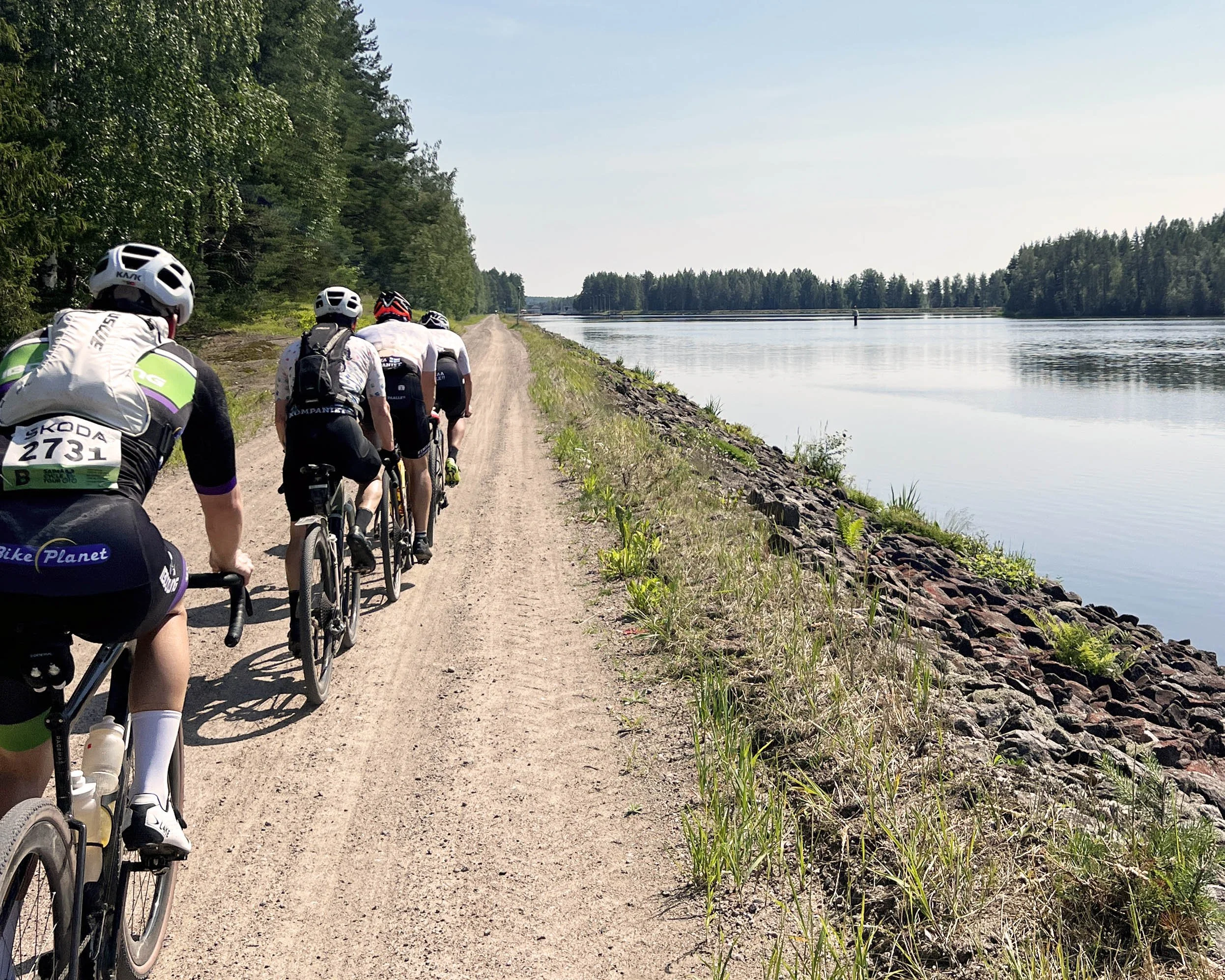
Sitting at the back of a small group at Saimaa Gravel Tour 2025. Beautiful scenery alongside the Saimaa Canal. Dust was not an issue that day.
What hours of breathing road dust at racing ventilation may do to your airways, and who should care most
I got an email from a reader and active writer asking how dust rising from gravel roads would affect the airways, given that some riders already experience asthma-related respiratory symptoms. I was not aware of any studies on this and thought this is a good opportunity to learn also myself and dig deeper into the literature.
So, picture the back of a gravel peloton on an unpaved road, and a brown cloud that never settles because the wheels keep lifting it. Every rider in the bunch breathes that cloud, hard, for the whole race. The rider off the front on the same road meets almost clean air. Same effort with a completely different lungful.
It is well known and documented (Adar et al., 2014)(Rice et al., 2015) that air pollution in the long term is harmful for health, but would the acute effects of inhaled soil and road dust actually cause symptoms and possibly narrow your airways in that moment?
What is gravel dust, really?
Most of the suspended material is silt- and clay-sized, and, crucially, the faster the wheels travel the larger the fraction of very fine, respirable particles. It may also contain traces of tyre, brake and road-wear particles (Williams et al., 2008)(Wagner et al., 2024).
Those finest particles matter most, because they are the ones that slip past the larynx (the voice box) and reach the lungs and the small airways. They also carry a disproportionate load of reactive metals. In other words, the part of the dust cloud you cannot see is the part your airways care about.
Exercise multiplies the dose
Here is the twist that makes cycling different from standing at a roadside. You do not breathe a concentration, you breathe a dose, and dose is concentration multiplied by how hard you breathe multiplied by how long you are out there. At rest you move six to twelve litres of air per minute. Riding hard, that can exceed 100 litres per minute, and up to around 200 L/min in the biggest male athletes (Zuurbier et al., 2009)(Holmberg et al., 2007), and you switch to deep mouth breathing that bypasses the nose's filter. Over a multi-hour race those numbers compound brutally. The biological proof is blunt: urban cyclists carry roughly 2.3 times more black carbon in their airway cells than pedestrians on the same streets (Nwokoro et al., 2012).
And the two worst factors line up precisely in the bunch. Only there do you combine the highest ventilation with the highest in-cloud particle concentration. The solitary breakaway rider, breathing just as hard, inhales comparatively little. For a gravel field, the relevant exposure is not distant city smog, it is the dust of the wheel directly in front.
Could dust act like a clinical asthma provocation test?
This is the heart of it. In the clinic we provoke airways two ways. Direct agents such as methacholine act straight on the airway muscle. Indirect agents, like mannitol or dry air, do not touch the muscle at all; they trigger the airway's own machinery, releasing natural mediators and firing irritant nerves, which is why they are so specific for genuinely inflamed, twitchy asthmatic airways (Coates et al., 2017)(Anderson, 2016)(Hallstrand et al., 2018).
Inhaled dust belongs squarely in that indirect family, and mannitol is its closest cousin. Coarse, insoluble particles land on the airway lining and switch on irritant-sensing nerve channels (TRPA1 and TRPV1) on the vagus nerve (Bessac & Jordt, 2008)(Deering-Rice et al., 2015). That signal runs to the brainstem and returns as a reflex command to the airway muscle to contract.
The evidence is actually pretty old: back in 1962, inhaled inert dust was shown to cause reflex airway narrowing that was completely abolished by atropine, the drug that blocks that nerve pathway (Widdicombe et al., 1962). A substance acting directly on muscle cannot be switched off that way. Dust can. The same atropine-sensitive reflex shows up with other inhaled irritants, such as wood smoke (Hsu et al., 1998).
So dust does not behave like a chemical that clamps your airways shut directly. It behaves like an indirect challenge: it works through your own nervous system, and it leaves the airway more sensitive to the next provocation (Nordenhäll et al., 2001). That is exactly the profile of mannitol and its use as a provocation agent.
Who should care, and results from population studies
If coarse mineral dust really narrows reactive airways, the population numbers should show it, and they do. Natural desert-dust events are an accidental experiment. On Saharan-dust days, paediatric asthma emergency visits rose measurably with the coarse particle fraction (Cadelis et al., 2014), and desert dust over Athens was linked to a 38% rise in asthma emergencies (Trianti et al., 2017). Across multiple Mediterranean cities, the crustal, dust-derived coarse fraction, the very material a gravel rider inhales, carries a real, measurable acute respiratory signal (Stafoggia et al., 2016).
The reassuring half of the story: healthy lungs handle a hard, dusty ride with little measurable change in lung function (Cole et al., 2018). The effect concentrates in airways that are already inflamed and hyperreactive, that is, in riders with asthma, and especially those whose asthma is poorly controlled, who race in the bunch (McCreanor et al., 2007).
The honest bottom line
Here I have to be straight about the limits. No one has yet done the decisive experiment: take asthmatic volunteers, give them a standardised, measured dose of mineral dust, and compare the immediate drop in lung function head to head with mannitol, for example. Until that study exists, the case rests on converging lines of evidence, reflex physiology, exposure data and dust-storm epidemiology, that are strong and consistent but indirect.
What does that mean for you on the bike? If your airways are healthy, the dust is unlikely to make a difference to your ride (other than dirty clothes and the bike, of course), though the long-term pollution story is a separate conversation. If you have asthma and you race gravel in a bunch, you are very likely the person in whom this matters most. Optimise your control, talk to your doctor about a pre-exercise strategy tailored to your needs, and do not dismiss a nagging cough or a tight chest after dusty races as simply being unfit. The dust in the wheel in front of you is, physiologically, a good deal more than just dirt.
References
Adar, S. D., Filigrana, P. A., Clements, N., & Peel, J. L. (2014). Ambient Coarse Particulate Matter and Human Health: A Systematic Review and Meta-Analysis. Current Environmental Health Reports, 1(3), 258-274. https://doi.org/10.1007/s40572-014-0022-z
Anderson, S. D. (2016). 'Indirect' challenges from science to clinical practice. European Clinical Respiratory Journal, 3(1), 31096. https://doi.org/10.3402/ecrj.v3.31096
Bessac, B. F., & Jordt, S.-E. (2008). Breathtaking TRP Channels: TRPA1 and TRPV1 in Airway Chemosensation and Reflex Control. Physiology, 23(6), 360-370. https://doi.org/10.1152/physiol.00026.2008
Cadelis, G., Tourres, R., & Molinie, J. (2014). Short-Term Effects of the Particulate Pollutants Contained in Saharan Dust on the Visits of Children to the Emergency Department due to Asthmatic Conditions in Guadeloupe. PLoS ONE, 9(3), e91136. https://doi.org/10.1371/journal.pone.0091136
Coates, A. L., Wanger, J., Cockcroft, D. W., Culver, B. H., et al. (2017). ERS technical standard on bronchial challenge testing: general considerations and performance of methacholine challenge tests. European Respiratory Journal, 49(5), 1601526. https://doi.org/10.1183/13993003.01526-2016
Cole, C. A., Carlsten, C., Koehle, M., & Brauer, M. (2018). Particulate matter exposure and health impacts of urban cyclists: a randomized crossover study. Environmental Health, 17(1). https://doi.org/10.1186/s12940-018-0424-8
Deering-Rice, C. E., Shapiro, D., Romero, E. G., et al. (2015). Activation of Transient Receptor Potential Ankyrin-1 by Insoluble Particulate Material and Association with Asthma. American Journal of Respiratory Cell and Molecular Biology, 53(6), 893-901. https://doi.org/10.1165/rcmb.2015-0086OC
Hallstrand, T. S., Leuppi, J. D., Joos, G., et al. (2018). ERS technical standard on bronchial challenge testing: pathophysiology and methodology of indirect airway challenge testing. European Respiratory Journal, 52(5), 1801033. https://doi.org/10.1183/13993003.01033-2018
Holmberg, H.-C., Rosdahl, H., & Svedenhag, J. (2007). Lung function, arterial saturation and oxygen uptake in elite cross country skiers: influence of exercise mode. Scandinavian Journal of Medicine & Science in Sports, 17(4), 437-444. https://doi.org/10.1111/j.1600-0838.2006.00592.x
Hsu, T. H., Lai, Y.-L., & Kou, Y. R. (1998). Smoke-induced airway hyperresponsiveness to inhaled wood smoke in guinea pigs: Tachykininergic and cholinergic mechanisms. Life Sciences, 63(17), 1513-1524. https://doi.org/10.1016/s0024-3205(98)00418-4
McCreanor, J., Cullinan, P., Nieuwenhuijsen, M. J., et al. (2007). Respiratory Effects of Exposure to Diesel Traffic in Persons with Asthma. New England Journal of Medicine, 357(23), 2348-2358. https://doi.org/10.1056/NEJMoa071535
Nordenhäll, C., Pourazar, J., Ledin, M.-C., et al. (2001). Diesel exhaust enhances airway responsiveness in asthmatic subjects. European Respiratory Journal, 17(5), 909-915. https://doi.org/10.1183/09031936.01.17509090
Nwokoro, C., Ewin, C., Harrison, C., et al. (2012). Cycling to work in London and inhaled dose of black carbon. European Respiratory Journal, 40(5), 1091-1097. https://doi.org/10.1183/09031936.00195711
Rice, M. B., Ljungman, P. L., Wilker, E. H., et al. (2015). Long-Term Exposure to Traffic Emissions and Fine Particulate Matter and Lung Function Decline in the Framingham Heart Study. American Journal of Respiratory and Critical Care Medicine, 191(6), 656-664. https://doi.org/10.1164/rccm.201410-1875OC
Stafoggia, M., Zauli-Sajani, S., Pey, J., et al., the MED-PARTICLES Study Group (2016). Desert Dust Outbreaks in Southern Europe: Contribution to Daily PM10 Concentrations and Short-Term Associations with Mortality and Hospital Admissions. Environmental Health Perspectives, 124(4), 413-419. https://doi.org/10.1289/ehp.1409164
Trianti, S.-M., Samoli, E., Rodopoulou, S., Katsouyanni, K., Papiris, S. A., & Karakatsani, A. (2017). Desert dust outbreaks and respiratory morbidity in Athens, Greece. Environmental Health, 16(1). https://doi.org/10.1186/s12940-017-0281-x
Wagner, S., Funk, C. W., Müller, K., & Raithel, D. J. (2024). The chemical composition and sources of road dust, and of tire and road wear particles, A review. Science of The Total Environment, 926, 171694. https://doi.org/10.1016/j.scitotenv.2024.171694
Widdicombe, J. G., Kent, D. C., & Nadel, J. A. (1962). Mechanism of bronchoconstriction during inhalation of dust. Journal of Applied Physiology, 17(4), 613-616. https://doi.org/10.1152/jappl.1962.17.4.613
Williams, D. S., Shukla, M. K., & Ross, J. (2008). Particulate matter emission by a vehicle running on unpaved road. Atmospheric Environment, 42(16), 3899-3905. https://doi.org/10.1016/j.atmosenv.2008.02.003
Zuurbier, M., Hoek, G., Hazel, P. V. D., & Brunekreef, B. (2009). Minute ventilation of cyclists, car and bus passengers: an experimental study. Environmental Health, 8(1). https://doi.org/10.1186/1476-069X-8-48